
Running your fingers through dry, damaged hair can feel frustrating before the day even begins. Instead of soft movement and healthy shine, the strands may feel rough, brittle, tangled, frizzy, or straw-like. Split ends appear faster, styling takes longer, and even simple brushing can lead to breakage.
Affiliate & Advertising Disclosure: LumiVexa is a reader-supported publication. Product purchases made through links on this website may generate an affiliate commission from Amazon Associates at no additional expense to the buyer. For details, please review the formal Affiliate Disclosure and Privacy Policy.
The issue is not always one single product. Dry or damaged hair often happens when the hair fiber loses moisture, natural oils, protein balance, or protective strength. Heat styling, coloring, bleaching, harsh shampoos, tight hairstyles, sun exposure, hard water, and over-washing can all weaken the outer cuticle layer that protects each strand.
Trying to fix the problem with random heavy oils or thick masks can sometimes make the hair feel coated instead of truly healthier. On the other hand, skipping conditioner or using strong clarifying shampoos too often can make already fragile hair even drier.
The better approach is a consistent repair routine that restores moisture, protects the hair barrier, reduces breakage, and keeps styling gentle.
Your Dry Hair Repair Routine
Dry or damaged hair needs a balance of hydration, nourishment, and protection. The goal is not to overload the strands with every treatment at once, but to build a simple routine that helps the hair feel softer, stronger, and easier to manage over time.
- Switch to a Gentle, Moisturizing Shampoo: Use a sulfate-free or mild shampoo that cleanses without stripping away too much natural oil. Focus shampoo mainly on the scalp, where oil and buildup collect, instead of rubbing the lengths aggressively.
- Condition Every Wash Day: Conditioner is not optional for dry or damaged hair. Apply it from mid-lengths to ends, where the hair is usually driest and weakest. Let it sit for a few minutes before rinsing so the softening ingredients have time to smooth the hair cuticle.
- Use a Weekly Deep Conditioning Mask: Once a week, replace regular conditioner with a richer hair mask. Look for ingredients such as shea butter, argan oil, coconut oil, aloe vera, glycerin, ceramides, or panthenol. These ingredients help improve softness, manageability, and moisture retention.
- Limit Heat Styling: Flat irons, curling wands, and high-heat blow dryers can make damaged hair worse. Let hair air-dry when possible, or use the lowest effective heat setting. Always apply a heat protectant before using hot tools.
- Trim Split Ends Regularly: Split ends cannot truly be repaired once the hair fiber has separated. A small trim every few weeks or months can prevent damage from traveling upward and make the hair look healthier overall.
Why Dry Hair and Damaged Hair Are Not Always the Same
Dry hair usually means the strands do not have enough moisture or natural oil. It may feel rough, frizzy, dull, or hard to style.
Damaged hair means the structure of the hair has been weakened. It may break easily, stretch when wet, split at the ends, or feel overly porous after chemical treatments.
Some people have both at the same time. For example, bleached hair can become damaged from chemical processing and dry because the cuticle no longer holds moisture well.
The best routine should support both needs: moisture for softness and strengthening care for reduced breakage.
Wash Day Routine for Dry or Damaged Hair
A better wash day can make a noticeable difference in how your hair looks, feels, and responds to styling.
- Detangle Before Washing: Use a wide-tooth comb or your fingers to gently remove knots before stepping into the shower. This helps reduce tugging when the hair is wet and more fragile.
- Use Lukewarm Water: Hot water can strip the scalp and hair of natural oils. Lukewarm water is gentler and helps prevent extra dryness.
- Shampoo the Scalp Only: Massage shampoo into the scalp with fingertips, not nails. Let the shampoo rinse through the lengths naturally instead of scrubbing the ends.
- Apply Conditioner Generously: Focus conditioner on the mid-lengths and ends. If your roots get oily quickly, avoid applying heavy conditioner directly to the scalp.
- Rinse Carefully: Rinse until the hair feels clean but not squeaky. Hair that feels squeaky-clean may be stripped and more likely to frizz.
- Dry With a Soft Towel: Avoid rough towel rubbing. Gently squeeze out water with a microfiber towel or soft cotton T-shirt to reduce friction and frizz.
Ingredients That Help Dry or Damaged Hair
Choosing the right ingredients can make your routine more effective. Dry hair usually needs moisture and softness, while damaged hair may also benefit from strengthening ingredients that improve the feel of weakened strands.
| Ingredient | Why It Helps |
|---|---|
| Argan Oil | Adds shine and helps smooth frizz. |
| Shea Butter | Softens coarse, dry, or textured hair. |
| Aloe Vera | Provides lightweight hydration. |
| Glycerin | Helps attract moisture to the hair. |
| Panthenol | Supports softness and smoother texture. |
| Keratin or Amino Acids | Helps temporarily strengthen the feel of damaged strands. |
| Ceramides | Support the hair cuticle and improve smoothness. |
Protein-based products can be helpful for damaged hair, but too much protein may make some hair feel stiff or dry. If your hair starts feeling hard, rough, or crunchy, balance protein treatments with moisturizing masks.
Common Mistakes That Make Dry Hair Worse
Many people accidentally make dry or damaged hair harder to manage by using habits that increase friction, stripping, or breakage.
- Washing too often can remove natural oils before they have a chance to protect the hair.
- Skipping conditioner leaves the ends more exposed to friction, tangles, and breakage.
- Using high heat daily weakens the hair cuticle and increases split ends.
- Brushing wet hair harshly can cause snapping because wet hair is more elastic and fragile.
- Using too many heavy oils can make hair look greasy without solving dryness inside the strand.
- Sleeping with loose, tangled hair can create friction overnight and lead to more breakage.
Simple Weekly Hair Care Plan
A consistent weekly plan is easier to follow than a complicated routine. Start simple, then adjust based on how your hair responds.
| Day or Moment | Hair Care Step |
|---|---|
| Wash Day | Gentle shampoo, conditioner, leave-in conditioner, air-dry or low heat. |
| Midweek Refresh | Light leave-in spray or serum on dry ends. |
| Treatment Day | Deep conditioning mask for moisture and softness. |
| As Needed | Trim split ends, protect hair before heat styling, use gentle hairstyles. |
If your hair is very dry, you may not need to wash it every day. Many people with dry or damaged hair do better washing two to three times per week, depending on scalp oil, lifestyle, and hair texture.
Dry Hair vs Damaged Hair: What Does Your Hair Need?
Most people treat split, brittle, or frizzy hair with a one-size-fits-all solution: layering on heavy oils and masks. However, treating structurally broken hair with basic moisture—or overloading dehydrated hair with intense protein reconstructors—is one of the most common mistakes that can ruin your hair texture.
While dry hair and damaged hair share similar visual warning signs, they operate under entirely separate mechanical problems. Understanding the underlying chemistry of your strands is the absolute key to restoring healthy, bouncing length.
| Hair Concern | Common Signs | Best Product Focus | Helpful Routine Step |
|---|---|---|---|
| Dry Hair | Feels rough, frizzy, dull, or hard to smooth. | Moisture-rich conditioner, leave-in conditioner, hydrating mask. | Use conditioner every wash day and apply a weekly moisturizing mask. |
| Damaged Hair | Breaks easily, has split ends, feels weak, or stretches when wet. | Strengthening treatments, protein support, bond-care products. | Limit heat, trim split ends, and use a repair treatment as needed. |
| Dry & Damaged | Feels brittle, tangles often, looks dull, and breaks easily. | Balanced moisture and strengthening care. | Alternate moisturizing masks with gentle strengthening treatments. |
| Frizzy Hair | Puffy texture, flyaways, or humidity reaction. | Smoothing serum, leave-in cream, anti-frizz oil. | Dry with a soft towel and seal the ends with a lightweight serum. |
| Split Ends | Ends look thin, separated, rough, or feathered. | Temporary smoothing serum and protective styling. | Schedule regular trims and avoid high heat on the ends. |
The Big Hair Myth Broken
- Dry hair is a moisture deficiency that primarily alters the surface behavior of the strand. It occurs when the scalp’s sebaceous glands do not produce enough natural oils to lubricate the hair shaft, or when external factors strip that layer away. Dry hair lacks elasticity and shine, but its core internal structure remains perfectly sound. It simply needs moisture-binding emollients to seal its outer layer.
- Damaged hair is a structural protein failure. It is not a lipid or moisture issue; it is a physical breach of the internal cortex. Caused by chemical processing (like bleaching, coloring, or perming), aggressive heat styling, or mechanical friction, damage means the internal keratin disulfide bonds are torn apart. Damaged hair is highly porous, absorbs water instantly like a sponge, but lacks the structural integrity to hold onto it, causing it to stretch and snap.
Understanding Cuticle and Fiber Chemistry
To fix hair effectively, we must look at it under a microscope rather than treating it like a living organism. Hair strands are dead, keratinized filaments comprised of three main architectural zones:
- The Cuticle: The outermost protective shield, made of clear, overlapping keratin scales arranged like shingles on a roof. A healthy cuticle sits flat, reflecting light and locking in moisture.
- The Cortex: The fibrous middle layer that makes up 90% of the strand’s structural weight. This is where your hair’s keratin chains, peptide links, and disulfide bonds sit. It dictates the hair’s tensile strength, elasticity, and pattern.
- The Medulla: The soft, spongy inner core found mostly in coarse or thick hair types.
When hair is merely dry, the cuticle shingles lift up due to friction or a lack of sebum coating. Moisture escapes from the cortex, leaving the strand looking rough, dull, and frizzy.
When hair is damaged, the cuticle shingles are completely broken off or melted away. Without that armor, the cortex is directly exposed to the environment, causing the internal protein matrix to degrade. This is why damaged hair needs targeted active ingredients to temporarily fill those structural craters.
Recommended Products
This deep-conditioning jar treatment is an absolute powerhouse for hair thirsty for genuine moisture restoration. Instead of floating on the surface, it floods parched strands with nutrient-dense lipids.
- The Application Technique: Section clean, damp hair and distribute a generous dollop from the mid-lengths down to the tips. To deeply drive the humectants into coarse textures, pop on a plastic shower cap and apply moderate heat with a hairdryer for 15 minutes before rinsing completely with cool water.
- The Real-World Formula Verdict: Blended with fair-trade shea butter, manuka honey, and mafura oil, this heavy treatment provides exceptional detangling and long-lasting smoothness for thick, coily, or high-porosity dry hair types. However, because it contains rich natural butter compounds, it features a highly concentrated, heavy texture. If applied to fine, straight, or low-porosity hair, it will completely weigh down the roots and leave a greasy, flat residue.
- Best For: Revitalizing thick, coarse, and highly dehydrated natural curl patterns.

- LOCKED IN MOISTURE : SheaMoisture Manuka Honey and Mafura Oil Intensive Hydration Hair Masque treats damaged hair with e…
- MADE FOR DRY, DAMAGED CURLS : Our moisture-replenishing formula is infused with Manuka Honey, Mafura Oil and Fig Extract
- FORMULA BENEFITS : Deeply hydrates to renew and soften curls
- A RETREAT FOR YOUR HAIR : This nutrient-infused mask deep conditions and locks in extreme moisture to strengthen and s…
- SUSTAINABILITY MATTERS : SheaMoisture intentionally uses Fair Trade Shea Butter that is organic and sustainably sourced …
A fortifying leave-in conditioning cream formulated specifically to support the structural strength of weak strands as they grow longer. It balances targeted hydration with anti-breakage support.
- The Application Technique: Apply a dime-sized amount to wet or damp hair immediately post-wash. Work it evenly from your roots to your tips, focusing primarily on fragile ends, and do not rinse it out. Style your hair as normal.
- The Real-World Formula Verdict: Infused with castor oil, black cumin seed, and ginger extract, this cream seals down raw cuticle transitions and adds great reflective shine. While it is incredibly effective at detangling brittle strands, users with low-porosity hair note that using too much can accumulate a slight surface buildup over consecutive days, so a light hand is recommended for fine textures.
- Best For: Preventing physical breakage and split ends on fragile, brittle hair types between wash days.
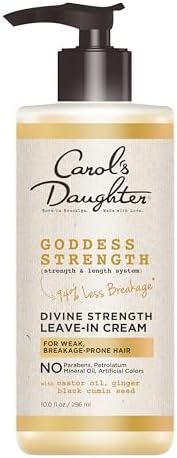
- LEAVE IN CONDITIONER: For dry damaged hair that intensely moisturizes and helps reinforce weak strands with every use; C…
- FORMULA: Hair Treatment made with Castor Oil and Black Seed Oil that makes hair stronger between washes and better resis…
- 15X STRONGER HAIR: Carol’s Daughter Goddess Strength Collection created for 4C, 4B, 4A, 3C, 3B, 2C, & 2B curl types; com…
- HOW TO USE: After using Goddess Strength shampoo, conditioner, and hair oil, apply to wet or damp hair and work in evenl…
- BLACK WOMAN FOUNDED: Lisa Price founded Carol’s Daughter in her Brooklyn kitchen in 1993 with a mother’s love and encour…
A high-tech bond-repairing spray designed to target broken disulfide bonds inside the cortex on a molecular level.
- The Application Technique: Distribute uniformly through clean, towel-dried hair prior to detangling or blow-drying. Focus application on areas with noticeable chemical damage or heat wear, combing through with a wide-tooth tool for uniform coverage.
- The Real-World Formula Verdict: This formula utilizes a low-molecular-weight polymer complex that can actually pass through lifted cuticles to temporarily bridge severed protein bonds. It offers incredible heat defense up to 450°F and leaves no heavy coating behind, making it a dream for fine hair. However, it does not offer heavy, oil-based slip; if your hair is intensely dry as well as damaged, you will need to follow up with a secondary light serum to smooth surface texture.
- Best For: Fine to medium hair suffering from severe chemical processing, bleach damage, or split ends.

- Reinforces and protects from the inside out
- Formulated with Rescuplex Bond Rescue Complex
- Smoothes and reduces frizz
- Protects from heat up to 450 degrees F
- Improves color vibrancy
A rich, high-gloss hair serum designed to wrap the external hair shaft in a protective lipid coat, sealing out moisture loss.
- The Application Technique: Warm two to three drops thoroughly between your palms, then scrunch it upward into the bottom third of completely dry hair to seal ends and banish surface frizz.
- The Real-World Formula Verdict: Packed with coconut oil and tiare flower extract, this penetrating oil acts exactly like a synthetic sebum layer, instantly restoring a glossy, reflective gleam to dull hair strands. Because it coats the cuticle so tightly, it serves as an excellent shield against atmospheric humidity. On the downside, it does not contain structural proteins, so it will not mend split ends or repair chemical damage—it is strictly a visual and surface texturizer.
- Best For: Eliminating stubborn surface frizz and imparting a glass-like shine to thick, dry hair.

- SOFT, TOUCHABLE, HEALTHY: An exotic & enticing ultra-rich blend w/ coconut oil & vanilla extract, this formula helps cre…
- BOUNCE AND SHINE: Treat your senses to an island escape with an ultra-rich repairing blend with coconut oil. This nouris…
- BEAUTY PURE & SIMPLE: Indulge your hair the way nature intended with OGX’s formulas inspired by unique ingredients; we’l…
- ROCK WHAT YOU’VE GOT: OGX hair care products are designed to bring out the best in your hair, no matter what type or tex…
Best Styling Tips for Damaged Hair
Styling should protect the hair instead of stressing it further. The more fragile the strands feel, the more important it becomes to reduce pulling, heat, and friction.
Use loose hairstyles more often, such as low buns, soft braids, claw clips, or low ponytails with silk or satin scrunchies. Avoid tight elastic bands that pull at the same spot every day.
Before blow-drying, gently remove excess water with a soft towel and apply a heat protectant. Hold the dryer a few inches away from the hair and keep it moving instead of concentrating heat on one section.
For overnight protection, sleep on a satin or silk pillowcase, or wrap the hair in a satin scarf. This reduces friction and helps the hair retain moisture better than rough cotton fabrics.
Final Thoughts
Dry or damaged hair does not usually improve from one product alone. It improves when the full routine becomes gentler, more moisturizing, and more protective.
Start with the basics: a mild shampoo, consistent conditioner, weekly deep treatment, less heat, gentle detangling, and regular trims. Over time, these simple habits can help the hair feel softer, shinier, stronger, and easier to style.
Healthy-looking hair is built through consistency. The more you protect your strands from daily stress, the easier it becomes to restore softness and natural movement.
Frequently Asked Questions
What is the best treatment for dry or damaged hair?
A weekly deep conditioning mask is one of the best starting treatments. If hair is chemically damaged or breaking, a strengthening treatment with proteins, amino acids, or bond-supporting ingredients may also help.
Can damaged hair be fully repaired?
Some damage can improve in appearance and feel, but split ends and severely broken hair can’t be permanently repaired. The best approach is preventing further damage and trimming weakened ends gradually.
Is oil good for dry hair?
Hair oils can seal in moisture, add shine, and reduce frizz — but they work best used lightly. Too much oil can leave hair feeling heavy or greasy without actually hydrating it.
Should I use heat on damaged hair?
Limit heat styling as much as possible. When you do use heat, apply a heat protectant first and choose the lowest effective temperature.
What ingredients should I avoid for dry hair?
Steer clear of harsh clarifying shampoos, alcohol-based styling sprays, and products with too much protein, which can leave hair feeling stiff or stripped rather than soft.
How long does it take to see results?
Most people notice softer, less frizzy hair within two to four weeks of a consistent routine. Deeper damage, like severe breakage or split ends, takes longer to manage since it depends on trimming and gradual growth rather than any single product.

Medical & Safety Disclaimer: The content featured on LumiVexa is for informational, aesthetic, and everyday entertainment purposes only. As a platform dedicated to beauty enthusiasm, content involves researching ingredient profiles, analyzing formulation catalogs, and identifying viral trends. Personal product testing is not performed, and operations are not conducted by a professional dermatologist, aesthetician, or medical provider. Because skin types react uniquely to different formulations, official manufacturer guidelines must always be reviewed, proper patch tests performed, and a certified health professional consulted before introducing any featured cosmetic or skincare product to a personal routine.